

In the world of SEO, trends come and go, but Google’s focus on content quality has always stayed the same. Even as AI tools like ChatGPT and Gemini change the way people discover information, one principle continues to guide what Google chooses to show. Content that shows real experience and genuine expertise will always stand out.
This is where EEAT comes in. It stands for Experience, Expertise, Authoritativeness and Trustworthiness. These qualities help Google understand which content is reliable, which businesses are credible and which pages actually help users make informed decisions. Whether your content appears in traditional search results or is selected by AI assistants, strong EEAT signals make a meaningful difference.
In this guide, I’ll explain what EEAT means, why it is important for SEO in 2025 and how it connects to the growing influence of AI. You will also find practical steps that help you strengthen these signals across your website and improve long term visibility.
What does EEAT mean?
EEAT stands for Experience, Expertise, Authoritativeness and Trustworthiness. These four qualities help Google evaluate the reliability and usefulness of your content. EEAT originally started as E A T, but Google added the second E in 2022 to recognise the value of first hand knowledge.
In simple terms, Google wants content written by people who have actually worked with the topic. If you write a product review, Google looks for signs that you have tested the product yourself. If you write about a service, Google wants insight based on real work rather than copied ideas.
What are EEAT signals?
EEAT signals are indicators of experience, expertise, authoritativeness, and trustworthiness which come together to show Google and your users why your content can be trusted.
Experience
Experience highlights your first hand involvement with the topic. Google wants to see that the information comes from someone who has actually done the work, used the product or dealt with the situation. Real examples and practical insights immediately set your content apart.
Expertise
Expertise focuses on your level of skill or knowledge. This can come from qualifications, certifications or long term experience. It is especially important in industries where accuracy matters, such as finance, legal services and healthcare.
Authoritativeness
Authoritativeness refers to your reputation. If others recognise your business as a trusted source, Google takes this as a strong signal of reliability. This might include reviews, testimonials, media features or links from reputable organisations.
Trustworthiness
Trustworthiness is the foundation of EEAT. Users should feel confident that the information is accurate, clearly sourced and up to date. Simple steps such as showing contact details, updating content and being honest about limitations help reinforce trust.
These qualities help your content rise above generic information online. They also work alongside the core elements of on page SEO to support strong search performance.
Why EEAT matters for SEO
Demonstrable EEAT is one of the clearest signals Google uses to determine whether content is safe and reliable. It is not a direct ranking factor, but it strongly influences how Google judges the quality of your pages. When your content shows experience, expertise and trust, it becomes easier for Google to recommend it.
This is especially important for topics that affect a person’s wellbeing or financial decisions. These subjects fall into Your Money or Your Life categories. If you are unsure how this is defined, my guide on what is YMYL content explains the criteria and why accuracy matters.
EEAT also reinforces your overall SEO strategy. Content that is trustworthy performs better, earns more engagement and maintains visibility during ranking shifts. It works alongside the core principles covered in our overview of local SEO and supports consistent performance across your site.
At its core, EEAT helps Google answer a simple question. Can this content be trusted. When the answer is yes, you are in a much stronger position to achieve stable, long term search results.
EEAT in the age of AI and generative search
AI has changed how people look for information. Tools such as ChatGPT, Gemini and Perplexity provide direct answers instead of a list of links. This shift has raised concerns about how websites remain visible when AI systems summarise content for the user.
Even with these changes, EEAT continues to guide what information is chosen. AI tools look for credible, well structured content written by people with genuine insight. Content that performs well in Google is often the same content that AI systems feel confident using.
Some marketers refer to this shift as Generative Engine Optimisation. We discuss the idea further in on our GEO page, but the key point is simple: the fundamentals do not change. Accurate and trustworthy information continues to rise to the top.
Strong EEAT signals help your content remain visible in both traditional search and AI generated responses. When your content shows clear expertise, AI and search engines can understand why it is a reliable source.
For reference, building EEAT is one of core considerations of our award-winning SEO content writers.
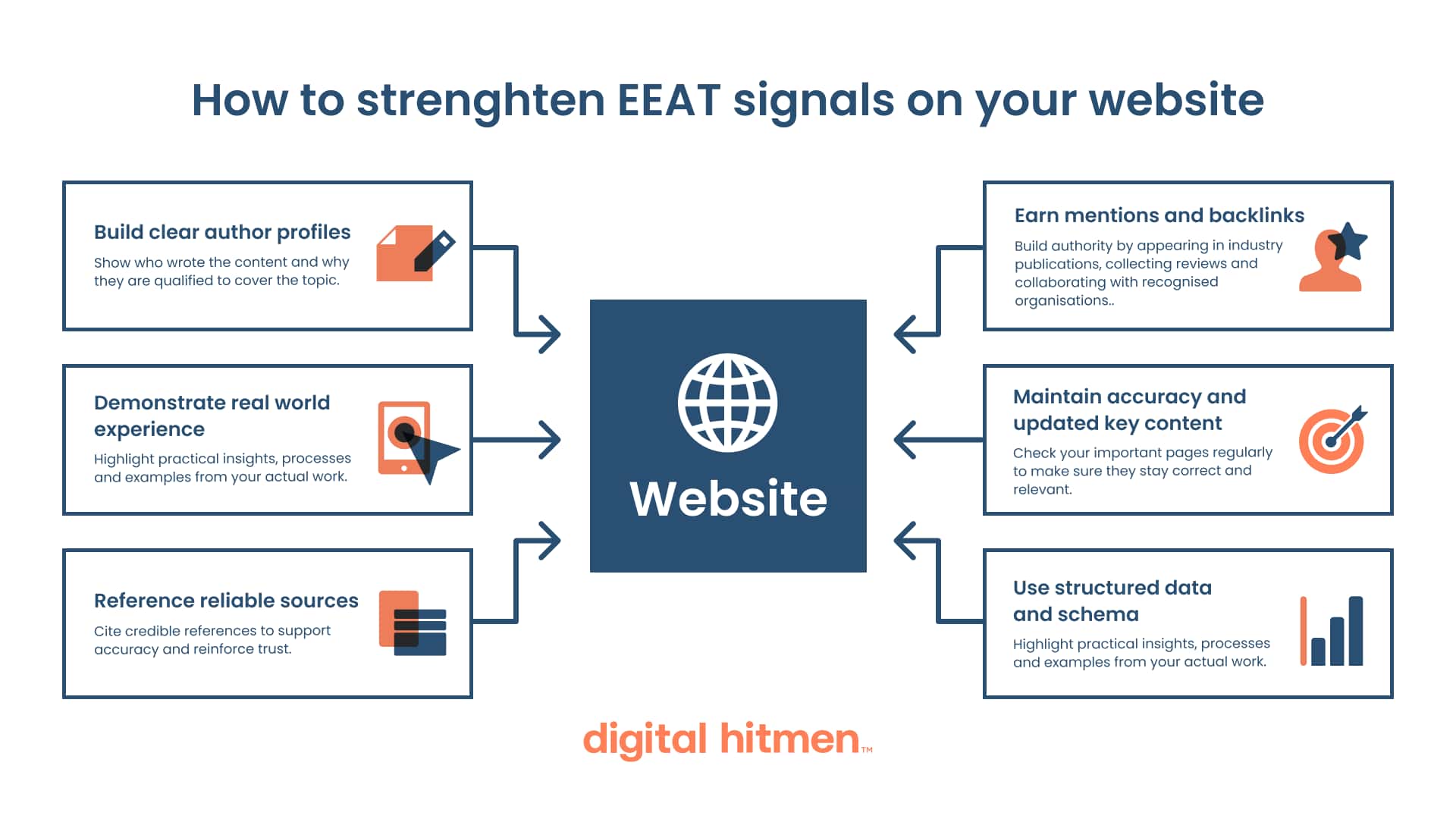
How to strengthen EEAT signals on your website
Strengthening EEAT does not require technical shortcuts. It is about confirming that your content is written by real people with real knowledge.
1. Build clear author profiles
Show who wrote the content and why they are qualified to cover the topic.
2. Demonstrate real world experience
Highlight practical insights, processes and examples from your actual work.
3. Reference reliable sources
Cite credible references to support accuracy and reinforce trust.
4. Earn mentions and backlinks
Build authority by appearing in industry publications, collecting reviews and collaborating with recognised organisations. This directly supports your visibility in Local SEO where reputation plays a key role.
5. Maintain accuracy and update key content
Check your important pages regularly to make sure they stay correct and relevant.
6. Use structured data and schema
Add basic schema for your organisation and authors to help search engines understand your site more clearly.
Common misconceptions about EEAT
There are several misunderstandings that lead to confusion. These are the most common:
“EEAT is a ranking factor”
It is not a direct ranking factor, but it strongly influences how Google assesses quality.
“EEAT only matters for YMYL topics”
It is essential for YMYL content, but all sites benefit from strong signals.
“AI content cannot show EEAT”
AI assisted content can still support E if it is reviewed and approved by a real expert.
“EEAT replaces SEO”
It does not replace SEO. It enhances it and works alongside on page SEO.
“EEAT only applies to articles”
It applies to all important pages, including service pages and location based content.
Key takeaways
EEAT is built on a simple principle. People trust information that comes from real experience and genuine knowledge. The more clearly your content reflects this, the better it performs in search and the more likely it is to be selected by AI tools.
AI may change how users search, but it does not change what good content looks like. Content that is accurate, honest and helpful will always earn visibility.
If you would like to strengthen your website’s authority and improve long term performance, our team can help you refine your SEO and content strategy. Talk to our SEO agency in Perth today about improving your visibility.